
Every self-publishing decision eventually comes down to one honest question: how much of this do you actually want to do yourself?
Lulu and Spines answer that question in opposite directions, and neither answer is wrong. Lulu is built for the author who wants to upload a finished, formatted file and pay only for printing and distribution.
Spines is built for the author who wants someone else handling the parts they don’t yet know how to do, in exchange for a package price.
The real comparison isn’t features. It’s which version of “self-publishing” you’re actually prepared to do.
Quick Comparison
- Cost model: Spines charges a single upfront package price covering the full process. Lulu is free to join and upload, with authors paying for printing costs and, if wanted, a one-time distribution fee.
- Royalties: Lulu pays 80% on print and 90% on ebooks, calculated after production costs. Spines pays a flat 70% net, calculated automatically.
- Production speed: Spines completes the full process, including distribution, in under 30 days. Lulu’s print file can go live in days, but global retail distribution takes six to eight weeks.
- Editing, formatting, and cover design: Included in every Spines package. Not included with Lulu, handled by the author or hired out separately.
- Marketing support: Spines includes an author platform and ad tools. Lulu offers no marketing support beyond a store listing.
- Audiobooks: Included in Spines packages. Not offered by Lulu in any form.
- Progress tracking: Spines runs on a real-time dashboard. Lulu’s process is self-managed, with support available through its help center.
| Spines | Lulu | |
| Starting cost | Package price, mid four figures and up | Free to join; pay for printing and distribution |
| Royalties | 70% net (flat) | 80% print / 90% ebook (after production costs) |
| Production speed | Under 30 days, full process | Days for a print file; 6–8 weeks for global distribution |
| Editing & formatting | Included | Not included |
| Cover design | Included | Not included |
| Marketing support | Included | Not included |
| Audiobooks | Included | Not offered |
| Progress tracking | Real-time dashboard | Self-managed |
| Support | Dedicated production manager | Self-guided, help center |
What “Free” Actually Means
Lulu costs nothing to create an account and upload a manuscript. That’s a genuine advantage if you already have a formatted interior, a finished cover, and a clear sense of how you want your book distributed.
You pay Lulu for printing costs and, if you want your book on Amazon, Barnes & Noble, and other retailers beyond Lulu’s own store, a one-time distribution fee.
What “free” doesn’t include is anyone doing the work for you. Lulu provides tools, not services. Formatting, cover design, editing, and proofreading are entirely on you, either through your own skills or by hiring freelancers separately.
For a first-time author who doesn’t yet know what a properly formatted interior even looks like, “free” can turn into a frustrating few weeks of trial and error before the platform will accept the file at all.
Spines works the other way. Packages start at a single upfront price, currently beginning in the mid four figures for the entry Signature tier and scaling up through Paramount and Horizon, and that price includes copyright protection, AI-assisted editing and formatting, cover design, distribution, and audiobook production. You’re not paying for access to tools. You’re paying so that you don’t have to learn the tools at all.
Neither model is objectively cheaper. An author who already knows how to format a manuscript and design a cover will spend far less going the Lulu route.
An author who doesn’t, and who would otherwise need to hire an editor, a formatter, and a cover designer separately, may find that Spines’ bundled price is actually the better deal once every piece is accounted for.

Overview of Spines
Founded in 2022, Spines aims to revolutionize the self-publishing industry with its AI-powered platform, providing authors with a seamless publishing experience.
By blending advanced technology with human expertise, Spines offers an efficient solution to combat traditional publishing challenges.
Spines offers a comprehensive range of services, including manuscript preparation, editing, book design, formatting, distribution, and marketing.
The innovative platform also provides full transparency, allowing authors to track their progress and make informed decisions throughout the publishing journey and providing all necessary services on a single, user-friendly platform.
Pricing for Spines starts at $1498, offering an affordable entry point for authors. This subscription includes access to all necessary publishing tools and services, making it a cost-effective solution for those looking to self-publish their books.
Despite entering the market not too long ago, Spines has quickly distinguished itself with a 4.5-star rating on Trustpilot, demonstrating that authors appreciate its modern solution to the outdated publishing world. Publishing an average of 5 books per day, Spines has become one of the leading publishers in the industry.
Spines – Key Features
One of the main differences is that Spines is a publishing platform, with a transparent and user-friendly dashboard that allows authors to easily track and manage their book’s production. With tailored plans that include essential services like editing, copyright protection, and ISBN assignment, Spines makes self-publishing more accessible and affordable for authors.

- User-Friendly Dashboard
- Advanced AI Technology
- Proofreading & Editing
- 100% Royalties
- Cover Design
- Global Distribution
- Marketing
- All Formats Generated (POD, eBooks, Audiobooks)
- Copyright Protection
- Dedicated Support
Does Not Offer
- Platform is not yet fully intuitive

Overview of Lulu
Lulu Publishing is a versatile self-publishing platform that caters to independent authors, small publishers, and creators looking for a range of product options. Founded in 2002, Lulu offers a free-to-use platform for book creation and distribution, allowing authors to publish without any upfront costs.
One of its standout features is the high royalty rates, with authors retaining 80% of profits from print book sales and 90% from eBooks.
Additionally, Lulu has no minimum order requirement, enabling authors to print as few or as many copies as needed.
The platform supports global distribution, making books available through major retailers like Amazon and Barnes & Noble, as well as other online and physical stores. Lulu also provides comprehensive print-on-demand services, ensuring books are printed only when ordered, which helps manage costs and avoid excess inventory.
Lulu – Key Features
- Free to Use: No upfront costs for book creation and distribution.
- High Royalties: Authors retain a significant percentage of profits (80% for print, 90% for eBooks).
- No Minimum Orders: Flexibility to print as few or as many copies as desired.
- Global Distribution: Access to major retailers and online stores, along with print-on-demand options.
Does Not Offer
- Basic Production Tools: Limited tools for formatting, cover design, and proofreading, requiring authors to handle these aspects themselves.
- No Marketing Services: Authors are responsible for their own promotion, as Lulu does not provide extensive marketing support.
- Complex Platform: The platform can be challenging for new users to navigate, and there have been reports of inconsistent print quality.
Comparing Pricing & Affordability
When it comes to affordability, both Spines and Lulu Publishing offer budget-friendly options for self-publishing authors, but with distinct pricing structures.
Spines Pricing
Spines offers a flexible pricing model with packages starting at $1498 for the Essential Package. The platform’s three-tier structure includes:
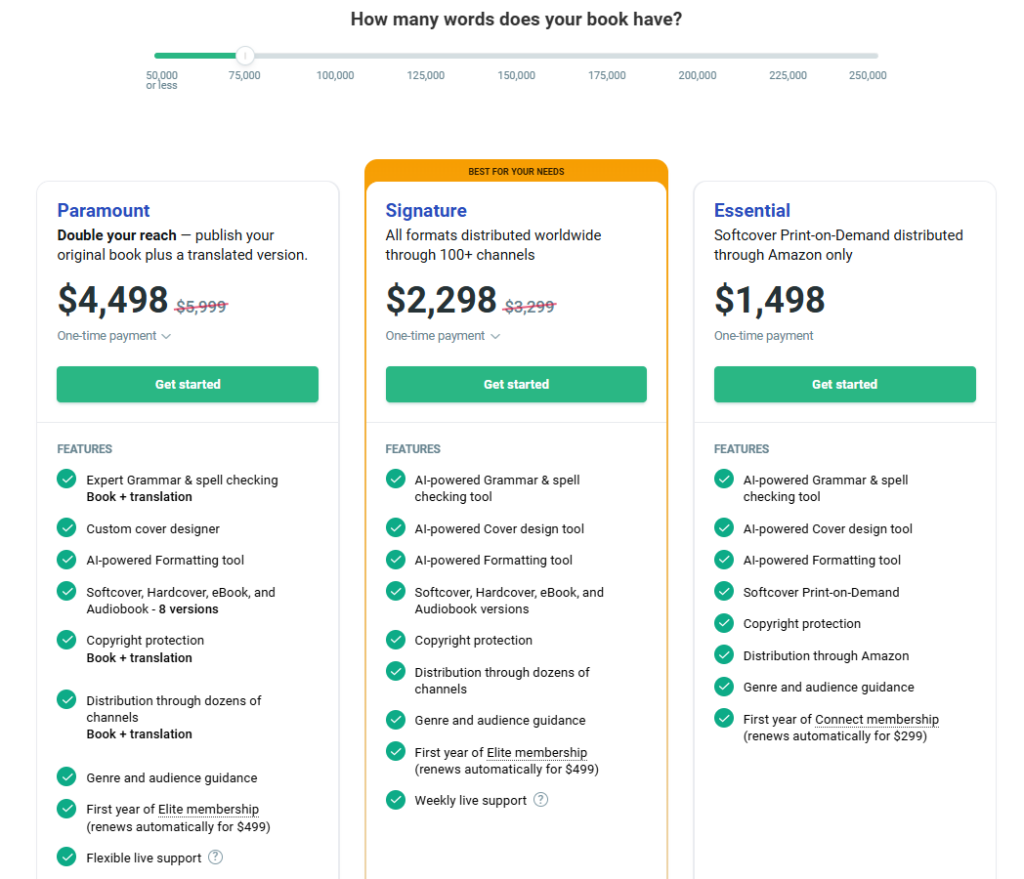
For more information on Spines pricing system, visit their webiste.
Lulu Pricing
Lulu also offers a free-to-use platform for basic book creation and distribution, with no initial costs for uploading and publishing books. However, unlike KDP, Lulu provides a range of optional paid services, including cover design, formatting, and enhanced distribution, which can help authors with specific needs.
Lulu’s pricing structure is transparent, with cost calculators available to estimate expenses based on book specifications and service selections.
Comparing Prices
When comparing pricing, Spines offers flexible monthly plans starting at $125 per month, with more comprehensive packages up to $336 per month, providing full production services like editing and audiobook creation.
Lulu, on the other hand, is free to use for basic publishing, but authors pay for additional services like printing and distribution, making it more cost-effective upfront but requiring more hands-on effort. Both platforms offer competitive royalty structures, but Spines provides more comprehensive support with its pricing.


Royalties Aren’t as Simple as a Single Number
Here’s where it gets counterintuitive. Lulu pays a higher royalty percentage than Spines. Authors keep 80% of the profit on print books and 90% on ebooks through Lulu, once printing costs and any distribution fees are subtracted. Spines pays a flat 70% net royalty across its distribution channels.
On paper, Lulu wins that comparison. In practice, the percentage only tells you the split, not the total. Lulu’s royalty is calculated after production and distribution costs are deducted, meaning the number that reaches you depends heavily on your book’s price, page count, and which channels it sells through.
Spines’ 70% comes without you managing that math yourself, calculated automatically and shown on your dashboard as sales happen.
If you’re the kind of author who wants to run the numbers and optimize your own pricing to maximize what a higher percentage actually nets you, Lulu’s structure rewards that effort, and its royalty calculator lets you plug in a retail price and page count to see the exact payout before you commit to a number.
If you’d rather see one clear number and not think about production-cost math every time you adjust your retail price, Spines’ flat rate is simpler to reason about, even if it isn’t always the larger number.
Waiting for Approval vs. Watching It Happen
Spines typically moves from manuscript to publication in under 30 days. Lulu can be much faster for the print file itself, since uploading a ready book can go live in days, but global distribution to major retailers requires a separate approval process that generally takes six to eight weeks.
The distinction matters because it splits the timeline into two different products. With Lulu, you can have a printable book almost immediately, and a widely distributed one only after that longer approval window.
With Spines, the 30-day timeline already includes formatting, cover design, editing, and full distribution as one bundled process, so there’s no second waiting period after the first one ends.
Watching your book’s status is also handled differently. Spines runs on a dashboard that shows exactly where your manuscript stands at any point, without needing to check in with anyone. Lulu’s process is more self-directed.
You control the submission and can check status yourself, but there’s no equivalent of a personal production manager walking a first-time author through what each stage means or what to do if something gets rejected during formatting review.
Getting Read, Not Just Published
Publishing a book is not the same problem as getting people to read it, and this is where the two platforms diverge sharply rather than just by degree.
Spines includes marketing services inside its packages: an author platform, sales tracking, and the ability to launch ads on Facebook, Instagram, YouTube, LinkedIn, and Google directly from the dashboard. Lulu does not offer marketing support beyond listing your book in its own store and making it available through the retailers you’ve set up distribution with.
Whatever happens after that, reviews, social promotion, ad spend, is entirely the author’s responsibility.
This isn’t a knock on Lulu. Its entire model assumes the author is bringing their own audience-building skills or budget to the table.
But it’s worth being honest with yourself about whether you have that skill set already, or whether you’d be learning book marketing from scratch at the same time you’re learning to format a manuscript. Doing both at once is a lot for a first launch.
Print-On-Demand and Distribution
Both Spines and Lulu Publishing offer print-on-demand (POD) services, but they approach it differently.
Spines includes print-on-demand as part of its comprehensive publishing packages, ensuring that authors can print books as needed without the hassle of managing large inventories. Spines works with major global distribution channels like Amazon and Barnes & Noble, giving authors access to a wide-reaching network while handling all logistics behind the scenes. Authors can order copies through the Spines platform and have them delivered directly to their door.
Lulu Publishing has long been known for its robust print-on-demand capabilities, allowing authors to print books only when orders are placed, eliminating the need for upfront printing costs. Lulu’s POD service is highly flexible, enabling authors to print a single copy or larger quantities as needed. Books can be distributed globally through retailers like Amazon, but authors are responsible for managing print quality and distribution details.
While both platforms offer print-on-demand, Spines provides a more guided experience within its all-in-one platform, whereas Lulu gives authors greater control but requires more hands-on management. If you prefer a more seamless, hands-off process, Spines may be the better choice. However, if you prioritize flexibility and control over the printing process, Lulu excels in this area.
The One Format Gap That’s Real
Spines includes audiobook production in its packages. Lulu does not offer audiobook publishing at all, as a bundled service or an add-on.
If audio is part of your plan, whether now or down the line, that’s a hard limitation rather than a pricing difference, and it means starting an entirely separate process with a different platform if you want your book to exist in that format.
Both platforms support print and ebook formats and distribute through Amazon, Barnes & Noble, and other major retailers. Lulu has no minimum order requirement, so you can print a single copy for yourself or a large run, which is a genuine strength if you want tight control over your inventory.
Spines’ print-on-demand works similarly, producing copies as they sell rather than requiring you to warehouse stock, but it runs through the same account as your ebook and audiobook formats rather than as a separate a la carte purchase.
Support and Ease of Use
When it comes to support and ease of use, Spines provides a more hands-on approach. Every author is assigned a dedicated production manager, offering personalized guidance from manuscript preparation to distribution. This ensures that authors have a support system throughout the entire process, though some users have noted that the platform’s interface could be more intuitive, as it’s still being refined.
In contrast, Lulu Publishing offers a self-guided experience, providing authors with resources like guides and video tutorials. However, because much of the publishing process is managed by the author, the platform can be difficult to navigate, especially for beginners who may not have experience with formatting or design. While Spines offers more direct assistance, Lulu’s platform demands a steeper learning curve, making it less user-friendly for those new to self-publishing.
Customer Feedback
Spines has a 4.6-4.7 star rating on Trustpilot, with many users praising its blend of technology and human insight. Authors appreciate the efficiency and transparency of the platform, as well as the quality of services like editing and cover design.
Lulu has a mixed rating of 4.4 on Trustpilot. While some authors value the platform’s affordability and global reach, others mention issues with print quality and the complexity of the platform. Lulu’s lack of comprehensive customer support is a common concern, as many authors find the self-publishing process overwhelming.
Which is Right for You?
When choosing between Spines and Lulu Publishing, it depends on your needs as an author.
Spines is ideal for those seeking a comprehensive, guided publishing experience. By blending AI with professional oversight, Spines takes care of cover design, editing, and global distribution while keeping you involved. Its quick publishing timeline (30 days or less) and 100% royalty retention make it a great choice for authors who want speed and full control of their earnings.
Lulu Publishing, on the other hand, is more suited for authors comfortable with a DIY approach. If you prefer handling the publishing process yourself, such as formatting and cover design, Lulu offers flexible print-on-demand and distribution services with no upfront costs. This makes it a more budget-friendly option, particularly for experienced authors who don’t need extensive production support.
In summary, choose Spines if you want hands-on support, faster publishing, and higher royalties. Choose Lulu if you prefer more autonomy and are looking for a low-cost platform to manage your own publishing process. The decision hinges on whether you value a guided experience or independent control.