
Spines and IngramSpark aren’t really competing for the same author. Spines is a publishing service. IngramSpark is a distribution infrastructure.
Comparing them feature by feature can make it look like a straightforward matchup, but the honest question underneath is whether you want a platform that does the publishing work with you, or a pipe that gets a finished book into 40,000 retailers and libraries once you’ve already done the work yourself.
Quick Comparison
- What each one actually is: Spines is a full-service publishing platform covering editing, design, and distribution. IngramSpark is a print-on-demand and distribution network; it doesn’t offer editing, cover design, or marketing at all.
- Cost model: Spines charges a single upfront package price. IngramSpark no longer charges a title setup fee as of February 2026, but authors buy their own ISBN and pay per-copy print costs.
- Royalties: Spines pays a flat 70% net. IngramSpark doesn’t use a royalty percentage at all: authors set a wholesale discount, typically 40–55%, and keep what’s left of the list price after that discount and print costs are subtracted.
- Production speed: Spines completes production and distribution in under 30 days. IngramSpark has no equivalent timeline, since there’s no production process, only file upload and distribution setup.
- Marketing support: Spines includes marketing tools in its packages. IngramSpark offers free educational courses on marketing but no built-in tools or services.
- Reach: IngramSpark’s core strength is genuinely unmatched, over 40,000 retailers and libraries, including bookstore and library ordering channels that most competitors don’t reach. Spines distributes globally too, though its network isn’t built around the same library and bookstore wholesale access.
| Spines | IngramSpark | |
| What it is | Full-service publishing platform | Print-on-demand and distribution network |
| Editing & cover design | Included | Not offered |
| Cost | Package price, mid four figures and up | No setup fee; pay for your own ISBN and print costs |
| Royalties | 70% net (flat) | Author-set wholesale discount (40–55%), minus print costs |
| Production speed | Under 30 days, full process | No production process; upload and distribute |
| Marketing support | Included | Free courses only, no built-in tools |
| Retailer & library reach | Global distribution | 40,000+ retailers and libraries, strong bookstore/library access |
| Audiobooks | Included | Not offered |
| Progress tracking | Real-time dashboard | Account dashboard, print and sales reporting only |
| Support | Dedicated production manager | Email-based support, mixed reviews on response time |
What You’re Actually Buying
IngramSpark doesn’t sell you a publishing experience. It sells you access to the same wholesale ordering system that gets traditionally published books onto shelves at Barnes & Noble and into library catalogs.
That’s a genuine and rare strength. Bookstores and libraries order through Ingram the same way they’d order from a major publisher, which gives an independent book a kind of shelf-access legitimacy that most self-publishing platforms can’t offer.
What it doesn’t sell you is anyone helping you get the book ready. Editing, cover design, formatting, and marketing are entirely absent from IngramSpark’s offering, not available even as paid add-ons in most cases.
You arrive with a finished, correctly formatted file, or you don’t publish at all.
Spines sells the opposite thing: the work itself.
Copyright protection, AI-assisted editing and formatting, cover design, audiobook production, and marketing are built into the package price.
You’re not buying access to a distribution pipe. You’re buying someone to walk the manuscript through every step before it reaches one.
The Royalty Question Nobody Answers Simply
This is where the comparison gets genuinely confusing if you’ve only seen it summarized as a single percentage, because IngramSpark doesn’t have one.
Spines pays a flat 70% net royalty, calculated automatically and shown on your dashboard. IngramSpark works differently: you set a wholesale discount, the percentage of your list price that retailers and libraries pay to stock your book.
A 55% discount is standard if you want real bookstore and library orderability, meaning a retailer buys your $20 book for around $9. Print costs, typically $4 to $5 for a standard paperback, come out of what’s left, and a market access fee is deducted on top of that.
What remains is your actual payout, and it can be meaningfully smaller than “keep most of your royalties” makes it sound, especially on lower-priced books.
This isn’t a flaw in IngramSpark’s model. It’s the tradeoff for the wholesale access itself. A retailer won’t stock a book that doesn’t leave them enough margin to sell it profitably, so the discount that gets you onto shelves is also the discount that shrinks your per-copy income.
An author chasing the highest possible royalty and an author chasing bookstore shelf presence are optimizing for two different things, and IngramSpark is built for the second one.
Speed Isn’t Comparable, Because the Process Isn’t Comparable
Spines completes manuscript preparation, editing, design, and distribution in under 30 days as one bundled process. IngramSpark doesn’t really have a production timeline to compare it to, because there’s no production.
You upload a file that’s already formatted and designed, set your distribution and pricing, and the book becomes orderable. The speed of that step depends entirely on how ready your file already is, and how quickly you understand Ingram’s file specifications, which have a real learning curve around trim size, cover templates, and interior formatting for a first-time user.
That means the real timeline question for IngramSpark isn’t “how fast is publishing,” it’s “how long will it take me to prepare a file correctly on my own.” For an author with prior design and formatting experience, that can be fast. For a first-time author, it’s often where the process stalls.
Getting Read, Not Just Distributed
Spines includes marketing tools inside its packages: an author platform, sales tracking, and the ability to launch ads on Facebook, Instagram, YouTube, LinkedIn, and Google directly from the dashboard.
IngramSpark offers a free educational program covering topics like building an author platform and book marketing basics, but no built-in advertising tools or promotional services.
Distribution to 40,000 retailers means nothing is stopping a reader from finding your book once they’re looking for it, but nothing about IngramSpark itself makes a reader go looking in the first place.
Customer Reviews: What Authors Actually Say
Spines currently holds an “Excellent” rating on Trustpilot, sitting around 4.6 to 4.7 out of 5 from roughly 900 reviews. The recurring theme in positive reviews is the assigned production manager: authors frequently name their account representative directly and praise responsive, hands-on communication through what’s often a first publishing experience.
Where reviews turn negative, the complaint is usually about cost relative to what the author feels they got, with occasional mentions of an early account manager mismatch that got resolved once the author asked for a change.
IngramSpark holds a “Poor” rating on its official Trustpilot page, generally between 2 and 2.3 out of 5, though third-party aggregators like TopConsumerReviews and PissedConsumer put the figure closer to 2.6 to 3.2, so the exact number shifts depending on which source you check.
The consistent complaint across negative reviews is support itself: authors describe email-only contact and multi-day response times when something goes wrong with an order, a return, or a royalty question.
Positive reviews tend to focus on the distribution reach rather than the support experience, authors who already know the platform report the wholesale access delivering exactly what it promises.
Neither rating tells the full story alone. Spines’ score reflects a service-heavy experience where the account team drives most of the satisfaction difference. IngramSpark’s score reflects a self-service infrastructure that mostly works as long as you don’t need help using it.
Which One Actually Fits You
Choose IngramSpark if you already have a professionally edited, designed, and formatted manuscript, and what you actually need is wholesale-level distribution into bookstores and libraries that most platforms can’t reach. It rewards an author who’s already done the publishing work and now just needs the infrastructure.
Choose Spines if you need the work done, not just the distribution. If you don’t yet have a formatted file, a cover, or a marketing plan, and you’d rather pay one price for all of it bundled together with a dashboard that shows you what’s happening at every stage, Spines is built for that author specifically.
Some authors use both: preparing and launching through a full-service platform first, then adding IngramSpark distribution later once the file exists and bookstore or library reach becomes the priority. That’s not a compromise. It’s just recognizing that “service” and “infrastructure” solve different problems, and there’s no rule against needing both at different points.
Comparing Affordability
When it comes to affordability, Spines and IngramSpark cater to different financial strategies and author needs.
Spines Pricing
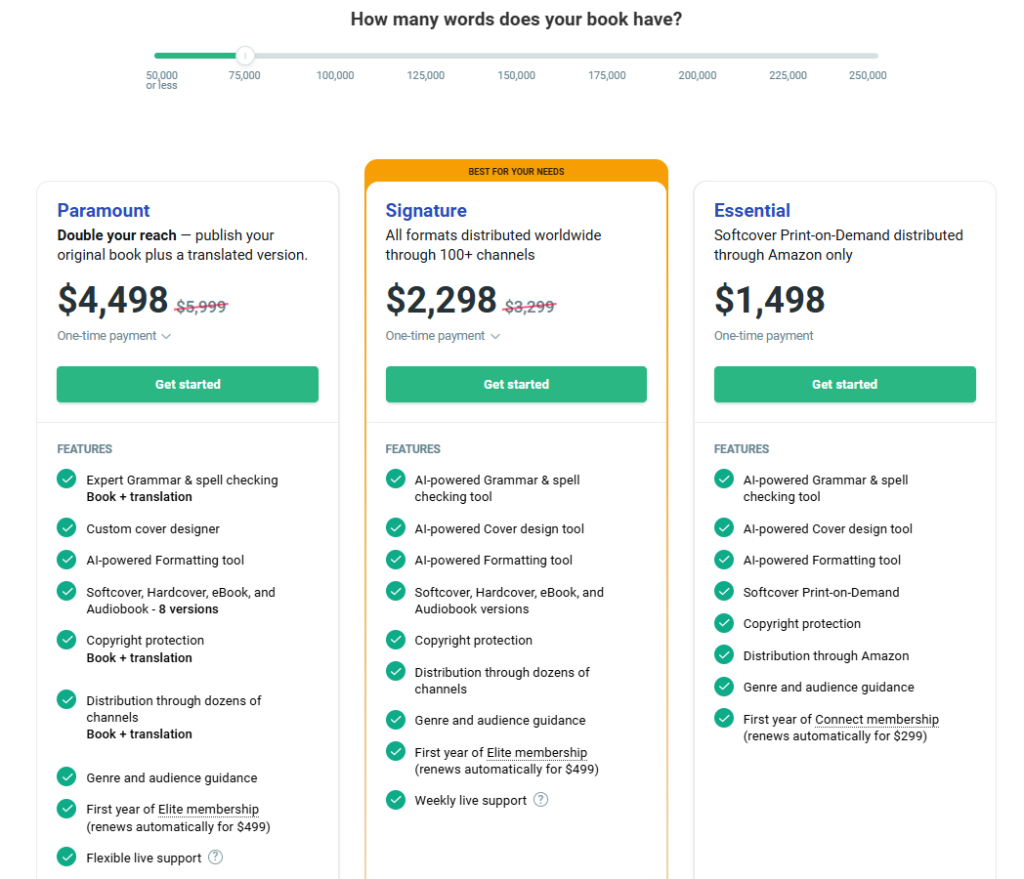
Spines offers a publishing model with three packages starting at $1498 for the Essential Package at 75,000 words, covering essential publishing needs like cover design, proofreading, formatting, and distribution. This structure is ideal for authors who prefer spreading out costs and offers flexibility with a one-time payment discount.
Each package includes a dedicated production manager, providing valuable guidance, especially for first-time authors.
For more information on Spines Pricing, visit their website.
IngramSpark Pricing
IngramSpark uses a pay-as-you-go model, charging $49 upfront for both print and eBook formats or $25 for eBook-only. While the initial cost is low, additional expenses for printing and wholesale discounts can add up. This model offers flexibility but requires careful budgeting, as costs can vary based on the services chosen.
Overall, Spines offers a more predictable, all-inclusive pricing structure, while IngramSpark’s à la carte approach may lead to higher costs depending on the author’s needs.


Publishing Timelines
Spines is known for its fast publishing timelines, allowing authors to see their books in print within 30 days. This quick turnaround is a significant advantage for authors eager to bring their work to market rapidly, making it an ideal choice for those with tight deadlines or who prefer a swift publication process.
The streamlined nature of Spines’ platform, combined with its use of AI technology, ensures that each step of the publishing process, from formatting to distribution, is completed efficiently without sacrificing quality.
In contrast, IngramSpark, while offering professional-grade printing and an extensive distribution network, typically requires a longer timeline to complete the publishing process. The focus on high-quality production, coupled with the complexity of managing global distribution, can lead to delays, making it a less suitable option for authors seeking a rapid release.
However, for those prioritizing professional print quality and global reach, the extended timeline may be a worthwhile trade-off.
Overall, if speed is a critical factor in your publishing decision, Spines offers a more favorable timeline, ensuring your book is ready for readers in just 30 days.
Marketing Services
Spines offers a comprehensive marketing toolkit designed to empower authors to effectively promote their books. This includes a variety of resources such as book marketing courses, customizable advertising options, and a personal author platform to drive sales and engage with readers.
Spines marketing tools are integrated into their platform, making it easy for authors to manage and track their promotional efforts in one place.
In contrast, IngramSpark, while renowned for its strong distribution capabilities, provides limited marketing services. Authors using IngramSpark must largely rely on their own resources to develop and execute marketing strategies.
While IngramSpark’s global distribution network ensures books are widely available, the lack of integrated marketing support means authors need to be proactive in promoting their work. This can be a challenge for those without prior marketing experience or the time to dedicate to creating and managing campaigns.
POD & Distribution
IngramSpark is a leader in the print-on-demand (POD) and distribution space, offering an extensive network that reaches over 40,000 retailers and libraries worldwide. This vast reach ensures that books published through IngramSpark are widely available, both online and in physical stores.
The flexibility of IngramSpark’s POD services allows authors to print books in various formats, including hardcovers, paperbacks, and eBooks, catering to different market demands without the need for large upfront print runs or inventory management.
Spines also provides robust POD services and global distribution, ensuring that books are printed on demand and distributed through multiple channels. However, while Spines’ network is comprehensive and effective for reaching a global audience, it is not as extensive as IngramSpark’s.
This means that while authors using Spines can still achieve significant distribution, their reach may be slightly more limited compared to the vast network offered by IngramSpark.
Overall, while both platforms offer reliable POD and distribution services, IngramSpark’s unmatched network and reach make it the better choice for authors seeking the broadest possible distribution.
Spines, however, remains a strong contender for those who prioritize an all-in-one platform with integrated services, even if the distribution network is slightly less expansive.
Support Services
Spines offers personalized support with dedicated production managers to guide authors through the process. IngramSpark’s support is available, but users have reported challenges in navigating the platform and receiving timely assistance.
If You’re Still Not Sure
The hardest part of this decision usually isn’t the comparison itself, it’s committing before you actually know how the process feels. Spines addresses that directly in two ways worth knowing about if you’re still on the fence.
Every package comes with a 30-day money-back guarantee, so committing to a tier doesn’t mean being locked in if the fit turns out to be wrong.
And you can schedule a free consultation with a publishing expert before you pay anything, to walk through your specific manuscript and get a real answer on timeline, cost, and what your book actually needs, rather than guessing from a pricing page.
IngramSpark doesn’t have an equivalent to either. There’s no guarantee to walk back from, because there’s no bundled service to refund, just print costs and distribution fees as you incur them. And there’s no consultation step, because the platform isn’t built around a conversation, it’s built around a file upload.
That’s not a criticism of IngramSpark. It’s just a reminder that the two platforms are asking something different of you before you even start: one wants a conversation first, the other wants a finished file.